Why Large Infrastructure Projects Fail at the Programme Level
Introduction
Large-scale infrastructure projects are rarely constrained by a lack of technical capability. In most cases, engineering solutions exist, resources are allocated, and delivery frameworks are established. Despite this, many projects continue to experience delays, cost overruns, and coordination breakdowns.
From a planning and project controls perspective, these failures are often rooted in programme-level issues that are not immediately visible during early execution phases.
The observations presented in this article are based on direct involvement in programme management and schedule analysis within complex, multi-stakeholder project environments, where coordination, sequencing, and delay risks play a critical role in project outcomes. These insights reflect recurring patterns observed in environments involving high interface density, evolving site conditions, and competing execution priorities.
1. Programme Complexity vs. Programme Control
As projects increase in scale, programme complexity grows significantly. Multiple contractors, overlapping work fronts, and interdependent activities create dense and highly interconnected schedules.
However, complexity alone does not cause failure. The issue arises when complexity is not matched with structured programme control.
- Schedules are populated with extensive activities but lack clear logic.
- Programmes are updated frequently without critical evaluation.
- Schedules are treated as reporting tools rather than decision-support systems.
This creates a disconnect between planned sequencing and actual execution priorities. As a result, teams may perceive steady progress while underlying risks remain unaddressed.
2. Sequencing Conflicts in Multi-Interface Environments
Large infrastructure and building projects involve multiple interfaces, including structural works, building services, architectural systems, and external elements.
These interfaces require tightly controlled sequencing.
In practice, sequencing conflicts arise when:
- activities are planned in isolation
- dependencies between trades are underestimated
- programme updates do not fully account for interface constraints
These issues can result in:
- out-of-sequence execution
- workspace congestion
- rework and inefficiencies
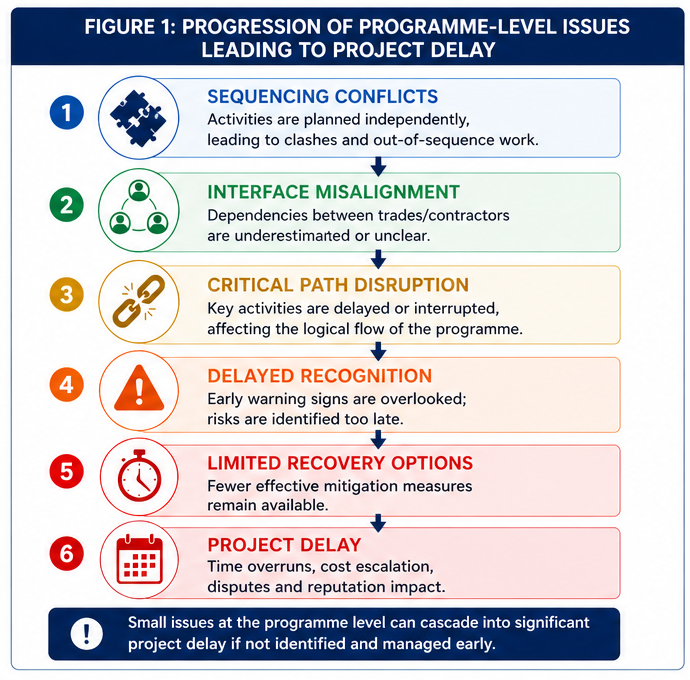
Figure 1 illustrates a typical progression of programme-level issues, where initial sequencing conflicts evolve into broader disruptions affecting the critical path. This structured interpretation highlights recurring patterns observed in complex project environments.
3. Misalignment Between Progress and Critical Path
The "Programme Visibility Gap"
One of the most common programme-level issues is the misinterpretation of progress.
Progress is typically reported through:
- percentage completion
- activity counts
- visible site output
However, these indicators do not necessarily reflect critical path performance, which ultimately governs project completion.
This creates what can be described as a Programme Visibility Gap: the difference between reported progress and actual progress along critical activities.
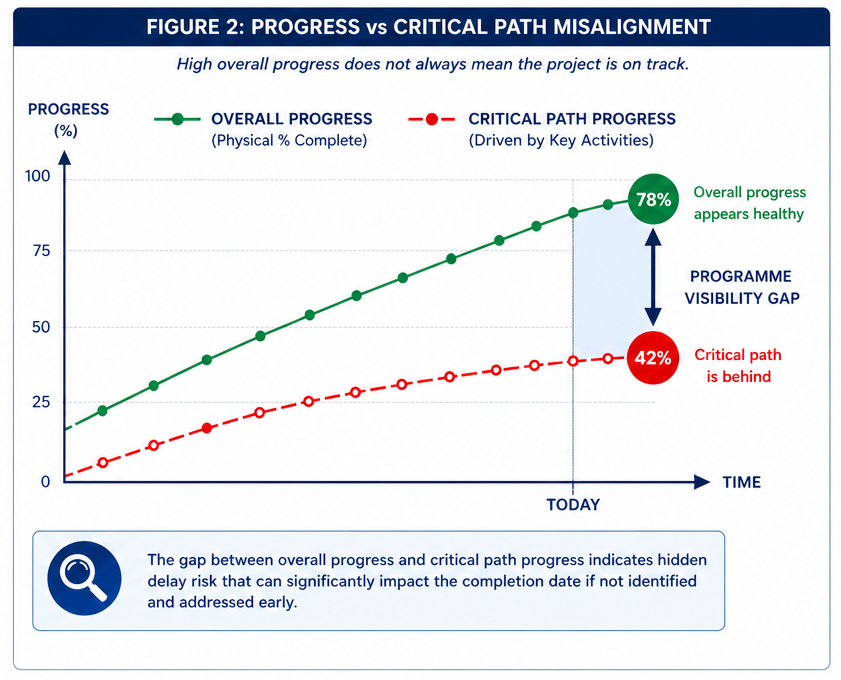
As illustrated in Figure 2, a project may demonstrate high overall progress while the critical path continues to slip. This divergence highlights how reliance on aggregate progress indicators can mask underlying schedule risks, reinforcing the need for continuous critical path evaluation.
4. Delayed Recognition of Programme Risks
Programme risks rarely emerge suddenly. In most cases, early warning signs are already present:
- slippage in predecessor activities
- excessive float consumption
- repeated resequencing
- increasing reliance on recovery strategies
However, these signals are often not acted upon in a timely manner.
When planning processes focus primarily on status reporting rather than forward-looking analysis, risk identification becomes reactive. By the time delays are formally recognized, recovery options are significantly constrained.
Addressing these conditions requires a more disciplined and structured approach to interpreting programme data, particularly in environments with high interface complexity.
5. Disconnect Between Planning and Decision-Making
Effective programme management depends on the integration of planning with execution and decision-making.
In some project environments, planning is treated primarily as:
- a contractual requirement
- a reporting function
rather than a decision-support mechanism.
This results in:
- programme outputs not influencing execution strategy
- identified risks not being translated into action
- management decisions being made without full schedule impact visibility
This disconnect reduces the effectiveness of planning and allows programme-level issues to escalate.
6. A Structured View of Programme Failure
The progression of programme-level failure can be understood as a structured sequence:
- Initial Conditions: Complex programme with multiple interfaces
- Disturbances: Sequencing conflicts, misaligned dependencies
- System Response: Critical path disruption and logic breakdown
- Delayed Recognition: Late identification of emerging risks
- Outcome: Reduced recovery options and project delay
This structured interpretation reflects recurring patterns observed across complex project environments and provides a basis for more proactive programme control.
Understanding this progression enables project teams to move from reactive responses toward earlier identification and management of risks.
7. Relevance to Large-Scale Infrastructure Delivery
The programme-level challenges discussed in this article are not region-specific. They are characteristic of large-scale infrastructure projects delivered in complex, multi-stakeholder environments.
These conditions are commonly seen across advanced construction markets, including Hong Kong, the United States, and other regions delivering major public works and transport infrastructure programmes.
Large infrastructure programmes often involve:
- multiple contractors, subcontractors, and specialist work packages
- complex regulatory, approval, and interface management processes
- publicly funded or multi-stakeholder delivery environments
- tight access, phasing, and sequencing constraints
These conditions increase the likelihood of coordination challenges, sequencing conflicts, delayed constraint resolution, and late recognition of programme-level risks.
The principles outlined in this article are not dependent on specific project types or regional practices, but are applicable to a wide range of infrastructure and building developments where programme complexity and interface coordination are critical. As such, the ability to identify and manage programme-level risks early plays an important role in improving delivery outcomes, controlling costs, and minimizing disputes.
8. Towards a More Effective Programme Approach
Improving programme performance requires a shift in how planning is applied within projects.
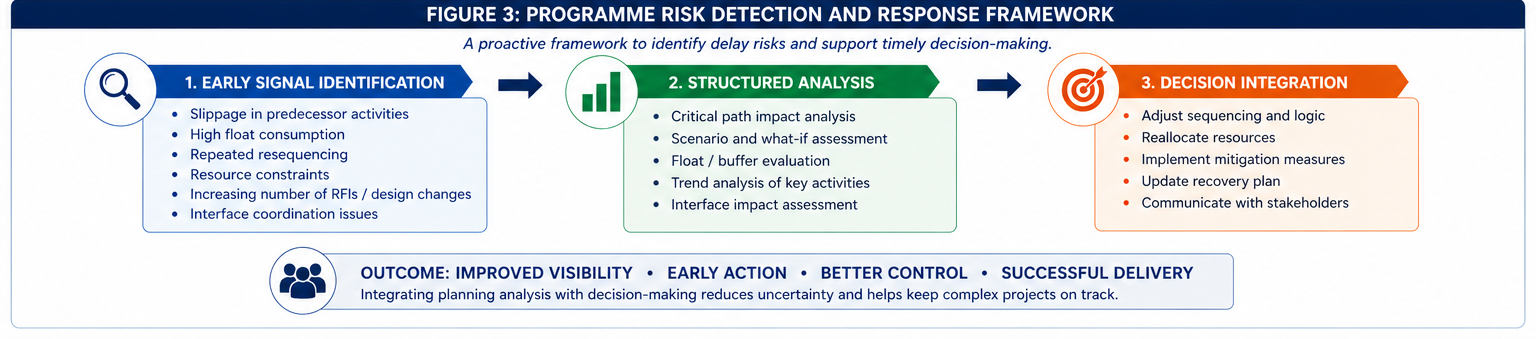
Figure 3 outlines a practical framework for programme risk detection and response, emphasizing the integration of analysis with decision-making:
1. Early Signal Identification
Recognizing early indicators of potential delay.
2. Structured Analysis
Evaluating impact through critical path and scenario assessment.
3. Decision Integration
Translating insights into actionable strategies.
This framework highlights the importance of linking early detection with timely intervention, rather than treating planning outputs as static reports.
Conclusion
Delays in large infrastructure projects are often attributed to external factors such as design changes or resource constraints. While these factors contribute, many underlying issues originate at the programme level.
Misalignment between progress and critical path, sequencing conflicts, and delayed recognition of risks collectively reduce the effectiveness of project delivery.
The approach outlined in this article reflects a structured perspective on programme-level risk identification and early-stage delay detection, which can be applied across complex infrastructure projects to improve planning reliability and decision-making.
By treating planning as a core analytical and decision-support function, rather than a reporting exercise, project teams can improve visibility, respond to risks earlier, and maintain greater control over delivery outcomes.
Professionals who can systematically identify and interpret programme-level risks contribute to more efficient, predictable, and resilient infrastructure delivery. Further exploration of structured delay detection approaches will be developed in subsequent work.