A Structured Approach to Early Delay Detection in Complex Construction Programmes
Introduction
In complex construction projects, delays are often identified only after their impact becomes visible. By the time schedule slippage is formally recognized, mitigation options are limited and recovery measures become increasingly resource-intensive.
This reactive pattern is not primarily caused by the absence of data, but by the absence of structured interpretation of programme signals.
Building on the programme-level challenges discussed previously, this article introduces a Delay Detection System (DDS), a structured approach to identifying early-stage delay risks through systematic interpretation of planning data.
The approach presented is based on direct involvement in programme management and schedule analysis within complex, multi-interface project environments, where early identification of delay drivers is critical to maintaining control over delivery outcomes.
1. The Limitation of Conventional Progress Monitoring
Traditional progress monitoring focuses on:
- percentage completion
- activity tracking
- variance reporting
While these indicators provide visibility of current status, they do not necessarily capture emerging risks embedded within programme logic.
This creates a condition where progress appears stable, but underlying programme disruption is already developing.
As a result, delay detection occurs only after critical activities are affected, limiting the effectiveness of response strategies.
2. Delay as a Progressive Condition
Delay should be understood not as a discrete event, but as a progressive condition that develops through identifiable stages.
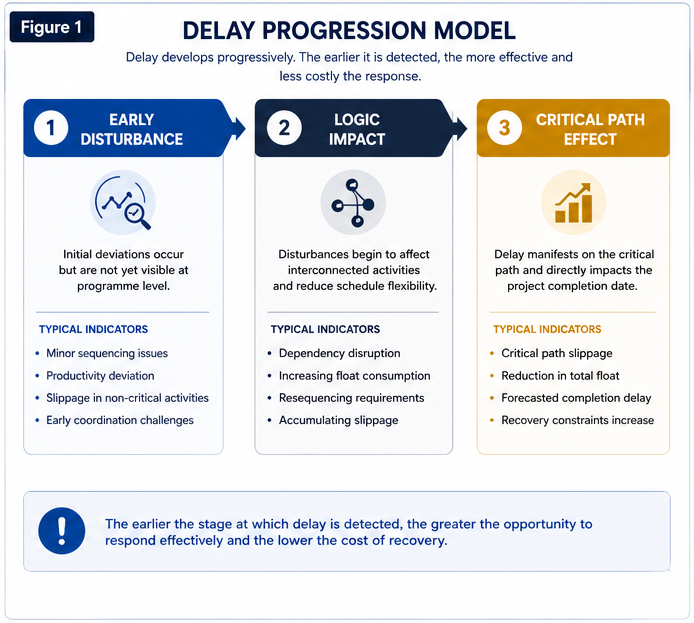
This progression typically follows:
Stage 1: Early Disturbance
Minor deviations in sequencing or productivity.
Stage 2: Logic Impact
Disruption begins to affect dependent activities.
Stage 3: Critical Path Effect
Delay becomes visible at project completion level.
This progression highlights that by the time delay is formally recognized, it has already passed through earlier detectable stages.
3. The Delay Detection System (DDS)
To address this limitation, a structured Delay Detection System (DDS) is proposed to enable earlier identification and interpretation of delay signals.
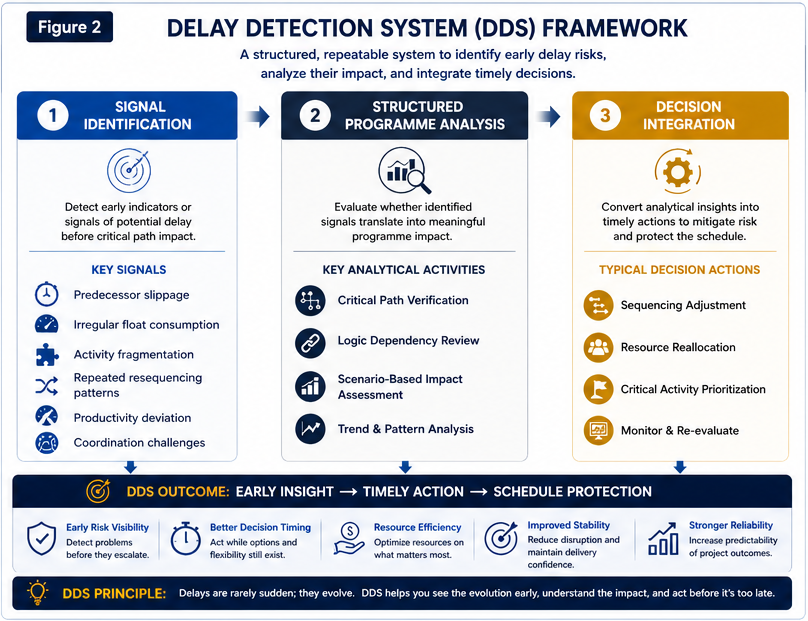
The DDS consists of three integrated layers:
Layer 1: Signal Identification
This layer focuses on detecting early indicators of potential delay before critical path impact occurs.
Typical signals include:
- slippage in predecessor activities
- irregular float consumption
- increasing activity fragmentation
- repeated resequencing of work
These indicators represent early disturbances that may not yet be reflected in overall project progress.
Layer 2: Structured Programme Analysis
This layer evaluates whether identified signals translate into meaningful programme impact.
Key analytical steps include:
- verification of critical path status
- review of logic dependencies
- scenario-based impact assessment
This stage distinguishes between isolated issues and systemic programme disruption.
Layer 3: Decision Integration
This layer converts analytical findings into actionable decisions.
Typical responses include:
- adjusting activity sequencing
- reallocating resources
- prioritizing critical path activities
The effectiveness of the DDS depends on how quickly insights are integrated into execution strategy.
This structured progression from signal identification to decision-making represents a repeatable approach to improving programme control.
4. Interpreting Programme Signals in Practice
In practical project environments, early delay signals are often subtle.
For example, minor delays in non-critical activities may appear insignificant. However, if these activities support multiple downstream operations, their impact can propagate rapidly.
Similarly, repeated resequencing may indicate deeper coordination issues, even when individual activities appear to be progressing.
These conditions reinforce the need to interpret programme data in context, rather than relying on isolated indicators.
5. Bridging the Interpretation Gap
A key limitation in programme management lies in the gap between:
- availability of schedule data
- ability to interpret that data effectively
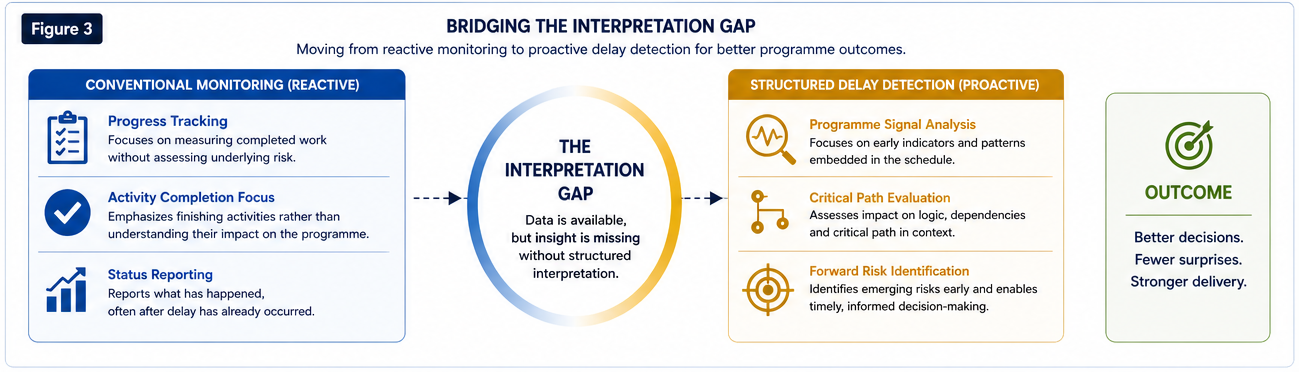
Project programmes typically contain sufficient information to detect risks early. However, without structured interpretation, this information remains underutilized.
The DDS addresses this gap by transforming raw schedule updates into structured, decision-oriented insights.
This transition is essential for moving from reactive reporting to proactive programme control.
6. Application to Infrastructure Delivery
The DDS is particularly applicable to complex infrastructure environments where:
- multiple interfaces exist
- dependencies are tightly coupled
- coordination challenges are significant
In the United States, infrastructure projects frequently involve:
- multi-contractor delivery structures
- regulatory complexity
- public accountability
These conditions increase the importance of early delay detection and structured programme analysis.
The DDS framework is not dependent on specific project types or regional practices, and can be applied across a wide range of infrastructure and building developments.
7. Towards Proactive Programme Control
The adoption of a structured delay detection approach enables a shift in planning philosophy:
From: monitoring completed activities
To: identifying emerging risks within the programme
This shift improves:
- timing of decisions
- allocation of resources
- stability of project execution
Conclusion
Delays in construction projects are often identified too late, when corrective actions become more complex and less effective.
The Delay Detection System (DDS) presented in this article provides a structured and repeatable approach to identifying early-stage delay risks through systematic interpretation of programme data.
By integrating signal detection, structured analysis, and decision-making, the DDS enhances the ability of project teams to respond to emerging risks before they escalate into critical path impacts.
This approach contributes to more efficient, predictable, and controlled project delivery, particularly in complex infrastructure environments where early intervention is critical.